
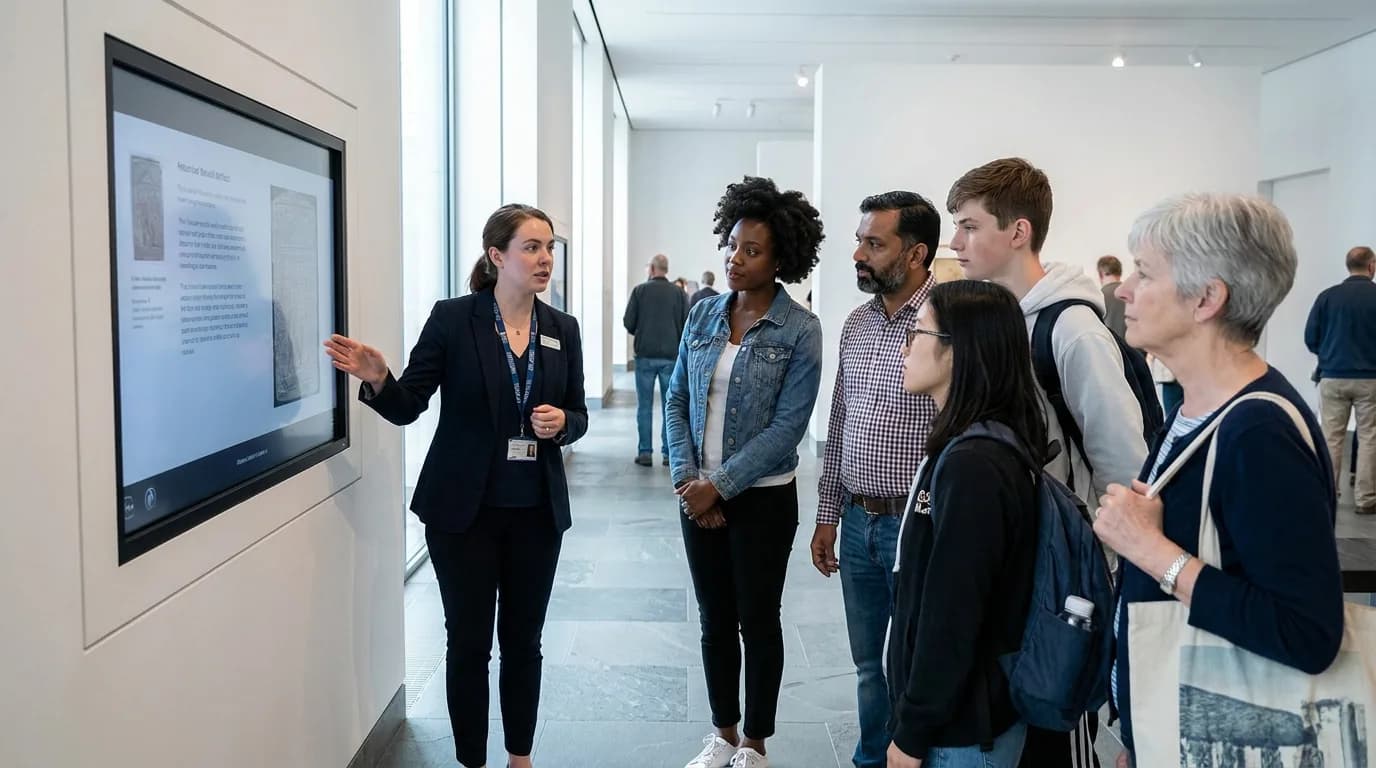
Digital interpretation in museums
Extinct species come back to life in a gallery, a Van Gogh answers visitors' questions, a hundred thousand works can be downloaded from home. Digital interpretation has left the screen fixed to the wall to reach the visitor, their language, their level, their time.
91 %
of French people aged 12 and over own a smartphone. The audience arrives equipped
2,5 M
artwork downloads in the first year, when Paris Musées opened its collections online
45 %
of France's museums only offer an audio guide or a visit application. The whole gap is there
Interpretation has changed its centre of gravity
Audiences did not wait for museums to go digital. They prepare, listen, download, and walk into the galleries with their habits.
Two and a half million downloads in the first year when Paris Musées opened its collections online. Museum stories listened to in children's bedrooms, visits prepared from the sofa, and 91% of French people walking through the door with a smartphone. The demand no longer needs proving, it is there, massive, equipped, used to stories that adapt.
Facing it, the offer long answered by equipping the galleries. Kiosks, touch tables, screens, installed at one point of the route, where the visitor had to come. The movement has reversed, interpretation now lives in the phone everyone brings, it follows the visitor from work to work, in their language, at their pace, and keeps talking to them before and after the visit. Fewer than one French museum in two offers an audio guide or a visit application today; it is in that gap, between what audiences already do and what venues offer, that the interpretation of the coming years is being decided.
The sector, meanwhile, is getting organised. The first full-scale study of these offers, published in January 2026 by the Observatoire des patrimoines of the Alliance Sorbonne Université with the agency Correspondances Digitales, lays out its four working areas, designing for durability, building together, measuring usage, making things last. A widespread practice, usage still rarely measured, sustainability becoming a design criterion. In other words, the subject has left experimentation and entered management.
The question is no longer what the museum installs. It is what the visitor takes away.
Four intents rather than a catalogue of devices
Screens, applications, headsets, podcasts, the list of media grows every year and says nothing. What sheds light on a project is the interpretive intent these devices serve, and what the venues carrying them have drawn from them.
Telling the story differently, in front of the work
In the Gallery of Evolution at the Muséum national d'Histoire naturelle in Paris, visitors put on augmented reality glasses and watch eleven extinct or endangered species take their place again among the naturalised specimens, guided by a voice, a passenger pigeon accompanying them from species to species. The REVIVRE experience, permanently installed since 2021, is lived in groups of five at most, glasses lent at the entrance, for about fifteen minutes.
At the musée d'Orsay, the Van Gogh in Auvers-sur-Oise exhibition closed on a device of another kind, a kiosk at the end of the route where anyone could put their questions to a conversational Vincent van Gogh, fed with the painter's some 900 letters. Making a work, or its author, speak is no longer a figure of speech.
The contribution. Dialogue and augmented images allow gestures the label ignores, asking one's question, seeing what has disappeared. The narrative stops being a notice and becomes an encounter.
The limit. It is not technical, it is a matter of balance. When the experience becomes the attraction, interest shifts from the work to the device, and the very screen interpretation was meant to remove is rebuilt in the middle of the gallery. These formats also stretch the visit, a quarter of an hour per group of five for a single room, and the arithmetic is quickly done in a venue with restricted capacity. Augmented images and dialogue keep their use cases, showing what has vanished, rehabilitating the naive question; they are judged by what they give back to the work, not by what they add to it.
Turning the visit into play
The Centre Pompidou took the logic all the way to a video game. Prisme7, free to download since 2020, has players explore forty works from the collection through colour, light and sound, in a soundscape created with a subsidiary of Ircam, with teaching notes for the classroom. A national museum publishing a video game would have raised smiles fifteen years ago; it says how firmly the playful register has settled into interpretation.
The contribution. The playful register reaches those the expert commentary does not, the child, the teenager, the classroom, and it travels without an entrance ticket, at home as at school.
The limit. A game is a production in its own right, with its own budget and calendar, it ages like software, and it lives beside the visit more than during it; nothing says the player becomes a visitor, for want, here again, of published measurement.
Reaching beyond the walls, before and after the visit
In 2020, Paris Musées opened up the images of its collections, one hundred thousand high-definition reproductions released under a free licence from day one, to download and reuse without condition. Two and a half million downloads in the first year, more than 170,000 works today, the City of Paris institution has turned its collections into a common good, consulted from China, the United States or Canada.
The podcast has taken the same road, the one that leads to the living room and the children's bedroom. The musée d'Orsay's Promenades imaginaires have paintings from the collection narrated by children's voices, seventeen episodes written by a children's author, to listen to before the visit or very far from it.
The contribution. Interpretation beyond the walls reaches those who do not visit yet, prepares the visit of the others and extends what the exhibition began.
The limit. It lives far from the works, without their presence, and its effect on actual attendance remains a conviction more than a measurement, the blind spot the 2026 study notes for the whole field.
Including those the standard visit leaves aside
At the Philharmonie de Paris, the content of the musée de la Musique in French Sign Language, in audio description and in easy-read versions can be consulted on the visitor's smartphone, or on a device lent to those without one. The Centre Pompidou, for its part, publishes an application for visitors with an autism spectrum condition, which serves first to prepare the visit, then provides adapted content on site.
The contribution. The same routes finally exist in several versions, and preparing in advance changes the very possibility of coming, for audiences long directed towards a few dedicated time slots.
The limit. Each version remains content to produce and keep up to date, and the most accomplished examples still come from large institutions.
Four intents, one constant. Each brings the story closer to the visitor, and each stumbles on the same step, content still largely identical for everyone who receives it, and usage few venues measure. That step is where what comes next is being decided.
The same route, several stories
The end point of the shift. One content, approved by the teams, and stories that adjust to whoever is listening.
The most stubborn limit of interpretation holds in one sentence, the same commentary for everyone reaches no one. Too scholarly for one, too fast for another, in a language the third does not speak. The most recent devices tackle exactly this point, adapting one scientific content into several registers, several durations and several languages, without multiplying the teams' writing work.
This is what Peekigo does, an intelligent visit companion, the visitor scans a work with their phone and a narration starts, adjusted to their profile, language and visiting time, built from content written and approved by the venue's teams. An eight-year-old child and an art history enthusiast do not hear the same story in front of the same painting.
Adapting one collection into several stories is already in the galleries. At the musée des Beaux-Arts in Dijon, the Nomade digital guide comments more than a thousand works through routes of one's choosing, masterpieces, the history of the dukes' palace, a family visit dotted with games, versions in easy-read, audio description and sign language, on the museum's free application or a tablet hired at the front desk. The same collection, told to visitors who are nothing alike.
The contribution. Adjustment tackles the first cause of disengagement, the gap between the story and the person receiving it, and it does so without multiplying the writing, one approved version, several renditions.
The limit. It moves the demand to the editorial side, defining the profiles, holding each register, keeping scientific approval at the centre, and market offers are not equal on this point, not all guarantee that the teams approve every piece of content before release.
Choosing the device that will carry these stories, handset, shared visit platform, bespoke or adaptive application, is an exercise of its own, with its criteria and its comparison; we covered it in our guide on choosing a museum audio guide well.
What the shift changes for the teams
Less hardware to manage does not mean less work. The load changes nature, it becomes editorial.
As long as interpretation settled into the galleries, it was managed like equipment, acquisition, maintenance, renewal. Carried by the visitor's device, it is managed like a publication. What used to be financed as kiosks is financed as writing, reviewing and translating, and the scientific message stays where it has always been, with the curators and interpretation officers. The load does not disappear, it changes nature, and it joins a craft the teams already have.
The shift also makes interpretation measurable, which in-gallery devices hardly allowed. Adoption rates, listening times, routes actually followed, languages requested, this data now exists natively, and the sector is only starting to seize it, the 2026 study makes measuring usage one of its four working areas.
Models that open up access
Entry conditions, meanwhile, have diversified. Some providers ask for an upfront investment, hardware or development, others operate with no initial outlay, others still earn by sharing the revenue of sales to visitors. For a venue with no equipment budget, this diversity decides access to the project itself; it is what stops digital interpretation from being reserved for the largest houses.
The reservations one hears, taken seriously
Four sentences come back in teams. None is a refusal of digital, all deserve better than a sales pitch.
“These devices will be obsolete in five years”
The worry is well founded, to the point of giving its subtitle to the sector's first full-scale study, what sustainability. There it reads as a design choice, environmental, economic, organisational and technological at once, not as a fate. And part of the answer belongs to no device at all, the texts, translations and recordings a venue produces remain its heritage, reusable whatever device carries them next.
“The screen will come between the visitor and the work”
It is the healthiest reservation in the profession, and it deserves to be turned into a criterion. A device is judged by where it takes the gaze. Those that make technology the show, however spectacular, push away the very work they claim to bring closer; those that step aside, a few seconds of screen to start the listening, then eyes back up to the work, serve it. Making the work accessible has never meant turning it into something digital. Immersion keeps the cases where it is irreplaceable, letting people see again what has vanished; everywhere else, contact and emotion remain the measure.
“We have neither the budget nor the team for a digital project”
That was true when every project began with an investment. The landscape has opened, models with no initial outlay exist, and Dijon's digital guide, with its adapted routes and its family visit, shows that a complete offer lives very well outside the largest houses. The scarce resource has moved to the editorial side, time to write and to approve, work that interpretation teams already carry for their labels and guided tours.
“Digital will end up replacing our mediators”
No case cited in this article points that way. In Dijon as at the Philharmonie, the device multiplies the teams' work, a thousand commented works no guided tour programme could ever cover, it does not take its place. And the only device in this overview that speaks freely, the conversational Van Gogh, is also the one that recalls why the mediator remains the guarantor, a story without an author commits no one.
What the visitor takes away
The best interpretation device is the one the visitor does not mention on the way out.
It does not tell of its kiosk, its headset or its application, it tells of the painting, the vanished species, the symphony. The venues crossed here share neither size nor budget, a national natural history museum, a municipal museum, a philharmonic hall, and the same thread runs through them, a story moving closer to the person looking, until it makes itself forgotten. The shift is under way, the equipment is waiting in visitors' pockets, the material exists in the object files. One question remains, to ask in front of one's own collection, what would it do with a story that adjusts to each of its visitors?
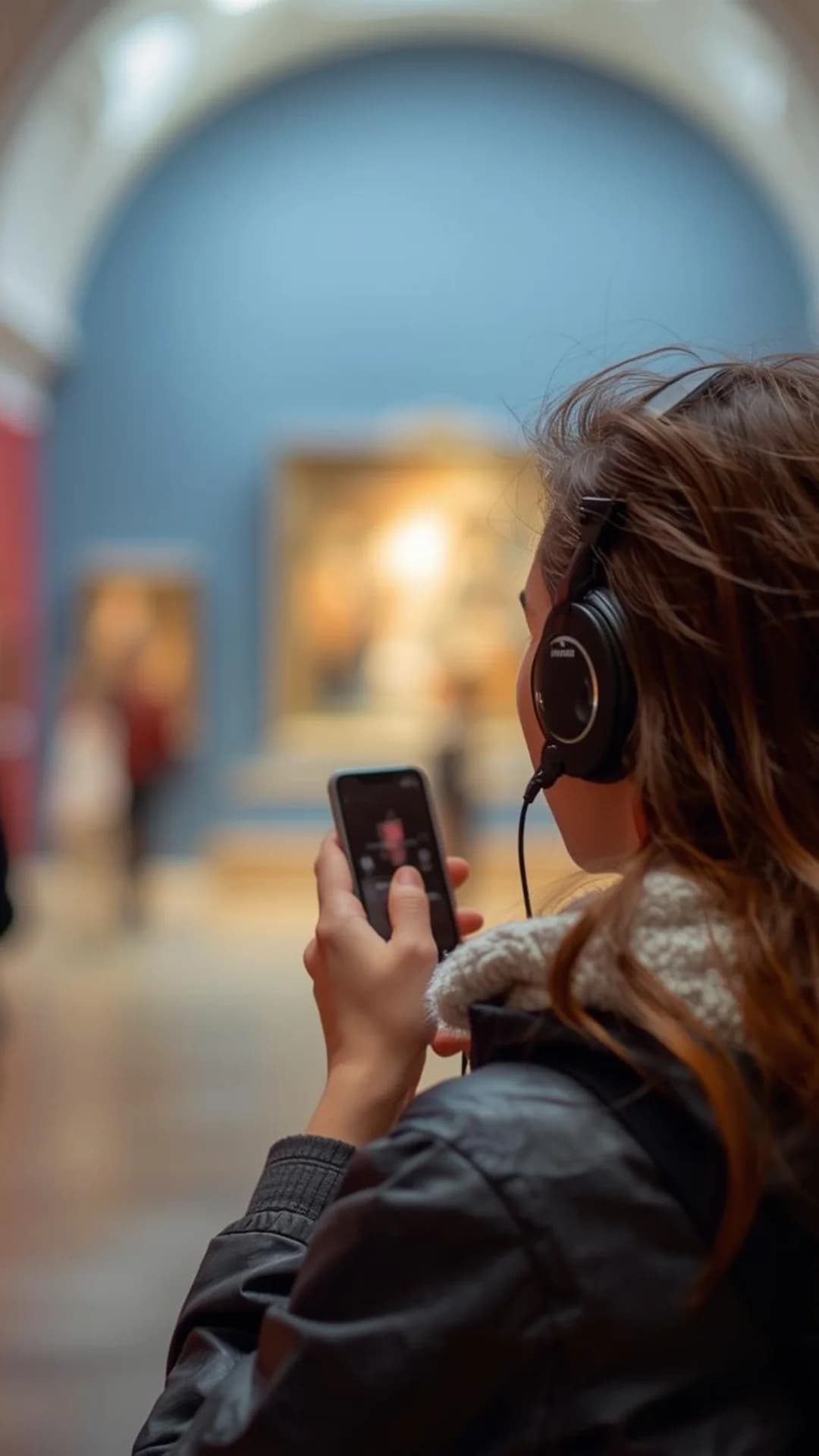
Peekigo, the intelligent audio guide that adapts to each visitor
Your works told to every visitor, in their language, on their smartphone, with no hardware to manage.