
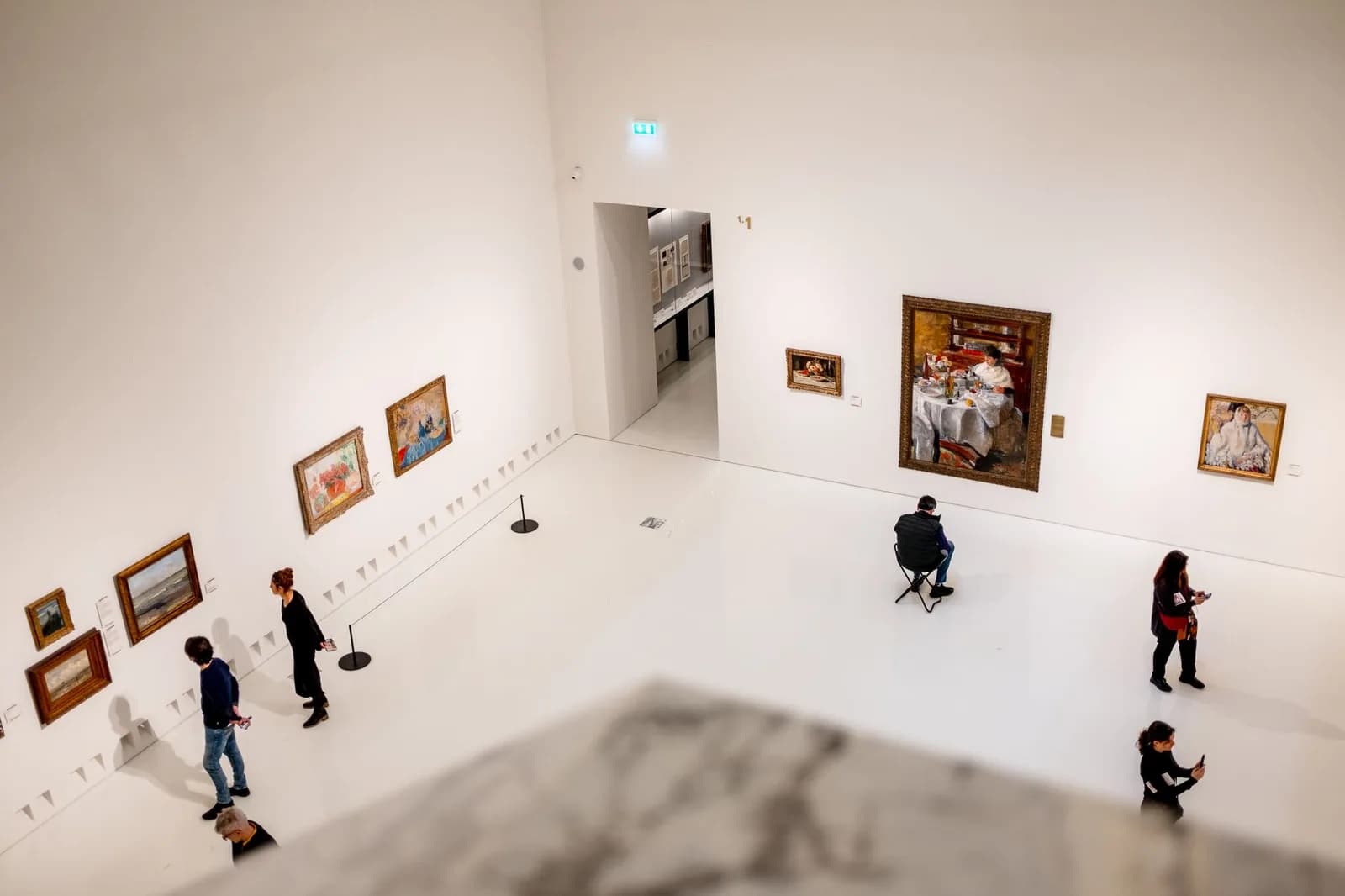
How to choose a museum audio guide
An audio guide no longer just narrates works. It adjusts the story to each visitor, turns the visit into a game, speaks every language in the audience and reaches well beyond the galleries.
-31 %
museum and exhibition attendance in eight years, from 62% of French people in 2017 to 43% in 2025
20 %
had no cultural outing in a year, although three quarters of them hold culture to be essential
86 %
nevertheless consider culture essential to their quality of life
An interpretation decision
Renewing an audio guide is most often approached as a matter of equipment, handsets to replace or an application to consider.
It is first and foremost an interpretation decision. The chosen device determines, for years, how the institution addresses its audiences. What if the question had changed nature without warning? While projects are being framed, the field of possibilities has moved. A Washington museum composes tours on demand, a Loire castle hides a treasure hunt in its rooms, a Louvre podcast is listened to at bedtime.
Attachment to culture does not weaken; attendance does. The survey conducted by IFOP for the Art Explora foundation places interpretation itself among the causes of this distance. A narrative judged too scholarly by some and too superficial by others leaves part of the audience at the threshold of the discourse.
The problem is not the desire for culture. It lies in the way it is told.
What visitors expect
Four findings that come back from one survey to the next, and what they imply for an interpretation device.
73 %
of visitors prefer to rely on a visit aid provided by the venue, whether an audio guide, a booklet or a map. The expectation of being guided has not weakened; it is the form of guidance that is in question.Baromètre des publics des musées, Institut Gece, 2025
65 %
consider that artificial intelligence devices can be a worthwhile complement to labels, audio guides and applications. Audiences do not expect less interpretation; they expect a better adjusted one.Baromètre des publics des musées, Institut Gece, 2025
32,5 M
visits to France's national museums alone in 2024, with a largely international audience in the most visited venues. Hearing the narrative in one's own language is not a comfort, it is the condition of access to the story.Patrimostat 2025, ministère de la Culture
Before
the visit already, a growing share of audiences prepares their route and chooses their themes, then extends the experience afterwards. The time of interpretation exceeds the time spent in the galleries.
These expectations outline three capacities that set devices apart, adjusting to the listener, speaking their language, accompanying them before and after the visit.
What today's audio guides make possible
This is the most open part of the project, and the one that decides which audiences a venue can go and win. Each of these possibilities already exists in a gallery, somewhere.
New ways of telling
A narrative that adjusts to each visitor. An art history enthusiast and a passing visitor do not hear the same commentary. Tone, level of detail and duration adjust to the profile, which answers the most frequent reproach made to interpretation, too scholarly for some, too superficial for others. This is what Peekigo does, an intelligent visit companion, the visitor scans a work and the narration adjusts to their profile, language and visiting time. The Smithsonian American Art Museum already offers this in its galleries, the visitor states their language, interests and time, and their tour is composed from content edited by the museum.
Several routes through the same hanging. A 45-minute masterpieces route, a behind-the-scenes visit, the eye of a guest artist. The same hanging carries several narratives, and each audience finds its own way in.
Voices we did not hear before. Sound archives, testimonies, a historical figure telling the story in the first person. At the Smithsonian American Art Museum, visitors hear the voices of more than a dozen artists, in archival recordings or recordings captured for the tour. The expert commentary is no longer the only form of the narrative.
Asking the work a question. Some recent devices let visitors ask their question in front of the work and receive an answer drawn from the content approved by the venue. Curiosity no longer goes unanswered.
New experiences in the galleries
A visit that becomes a game. Treasure hunts, riddles, quizzes from room to room. The playful register transforms the family visit, holds the attention of 8 to 12 year olds and gives teenagers a reason to take out their phone for the museum rather than against it. At Chambord as at the Conciergerie, the HistoPad treasure hunt has played this role since 2015, crowns hidden in the reconstructions and a treasure hunter certificate at the end (Domaine national de Chambord).
Augmented reality. Overlaying a vanished state on the work, animating a scale model, placing a monument back in its time. The HistoPad restores nineteen rooms of Chambord as they were in the time of François I. The smartphone becomes a window, no longer just an earpiece.
The free-flowing route. No more numbers to type, no imposed order. Visitors scan the work that draws them and listen to what they feel like hearing, in the order that suits them.
A wider welcome, data to steer
Every useful language, without multiplied production. Recent devices adapt one approved content into several languages without rewriting or re-recording per language. Language stops being a budget trade-off and becomes a decision about hospitality.
Accessible versions of the same routes. Audio description, subtitles, sign language versions, compatibility with hearing aids. The Smithsonian American Art Museum tour exists in American Sign Language, derived from the same approved content.
A visit that starts before the door and continues after. Preparing the route online, keeping favourite works, taking home material to go further. Les Odyssées du Louvre, co-produced with France Inter, tells the museum to 7 to 12 year olds all the way to their bedroom, more than 20 million listens for the first ten episodes (CLIC France).
Data per work and per route. Adoption, listening time, drop-off points, languages actually used. The venue sees what works and adjusts, exhibition after exhibition.
The criteria to weigh in your choices
Whether a project goes through a formal consultation or a few meetings, the same criteria set the offers apart.
01
Audiences served, audiences to win over
Today's profiles, those the venue wants to reach, families, teenagers, non-visitors, and the languages to cover. This direction is what lets candidates make a fitting proposal, and it is what decides whether the playful register or the sign language version enter the scope.
02
The narrative registers
Expert, general audience, playful, young visitors. A register is heard, not read on a brochure; it is in a voiced sample capsule, on one of the venue's works rather than a generic catalogue, that candidates really part ways. As a writing benchmark, a text read at a steady pace plays at around 150 words per minute.
03
Editorial control
The criterion that is not negotiable. The content played in the galleries is written, reviewed and approved by your teams, in every language, before any release. This approval is written as a requirement, never as an option, and a provider offering automatic generation without an approval chain is ruled out from the start, whatever its technology.
04
Ownership of the content
All the writing and approval work of your teams ends up in texts, recordings and translations. The question is who owns them. When the contract does not settle it, that content stays with the provider at renewal time, and the discussion starts over without leverage. The clause holds in one line, the venue owns its content and recovers it in a reusable format.
05
Behaviour under your network conditions
A fully online device, a caching device and a device with embedded content do not live the same visit in an old building. Depending on the coverage of your galleries, the questions change, need for a connection or not, handling without network, content caching, data consumption for the visitor. When everything is embedded, the subject disappears on its own.
06
Accessibility
Audio description, subtitles, sign language versions, compatibility with hearing aids. Offers diverge on one point, some treat these versions as a separate, separately billed work stream, others derive them from the same approved content, like the Smithsonian's sign language tour.
07
The data and its use
Adoption, listening time, drop-off points, languages actually used, in a format your teams can cross with ticketing, and visitor data processing that is GDPR compliant. It is what separates a device that improves from one exhibition to the next from a device you put up with.
08
The economic model
Market models no longer look alike. Most providers charge for a development upfront, a few operate with no initial investment, others earn through revenue sharing on sales to visitors. Three logics that look alike in a demonstration, and three very different budget conversations with your authority.
09
The connection with your website and ticketing
The visit is prepared online before it happens in the galleries, and continues afterwards. The link between the device, the venue's website and ticketing is a question institutions raise themselves in meetings, and one that offers handle unevenly, from a plain outbound link to real integration.
10
Visibility in the galleries and at the front desk
A device that nothing signals goes unused, whatever its quality. Signage at the decision points, an offer at the front desk, a mention on online ticketing; the French Ministry of Culture's practical guide (2020) ranks signage and pricing policy among the management points of an audio guide project.
Four families, judged on audience expectations
None is disqualifying in itself. They involve neither the same costs, nor the same load for the teams, nor the same experience for the audiences.
Four families share today's projects. The handset rented at the front desk, the historic audio guide. The shared visit platform, an application gathering the routes of many museums; the venue publishes its own there, and the visitor installs a single application for all participating venues. The application developed bespoke for a single institution. And the adaptive intelligent application, built on AI, which adapts one approved content into several tones, themes, languages and registers, play included. Borders are moving, some platforms now include adaptive features; the table judges the dominant logic of each family, against audience expectations and the possibilities described above.
| What audiences expect | Rented handset | Shared visit platform | Bespoke application | Adaptive application (AI) |
|---|---|---|---|---|
| Adjusting to the visitor | A single commentary, for everyone | From fixed routes to composed ones, depending on the platform | Defined once, then frozen | Tone, themes, duration set for each person |
| Opening up to play and new experiences | A single register, the commentary through the handset | Depends on the features the platform offers | Possible, each experience is a development | Multiple registers and formats on the same approved content |
| Speaking their language | Limited to recorded tracks | Depends on the languages produced by the venue | Each language is a development | Multilingual, without multiplied production |
| Accompanying before and after | Starts and ends at the front desk | Often limited to the visit itself | Depends on the development | Preparation beforehand, extension afterwards |
| Leaving control to the teams | Re-recording at every change | Within the framework set by the platform | Total, but every change goes back to the developers | Content written and approved by the venue |
| Knowing the audiences | Little or no data | Platform data, often partial | Depends on the development | Adoption, listening, satisfaction, routes |
| The economic model | A fleet to acquire, recharge, maintain | Subscription, no hardware | Initial development investment, then maintenance | Varies by provider, sometimes with no initial investment |
Each approach has its use case
The rented handset remains relevant for a venue with no usable network coverage, or whose audience is entirely captive. Everywhere else, its daily logistics weigh more than its services.
The shared visit platform makes sense to exist quickly on smartphones on a tight budget, accepting the framework and the limits of an application shared by many venues.
The bespoke application holds up for an institution that wants a fully distinct digital identity and has a permanent technical team. The initial investment and maintenance are part of the choice.
The adaptive application (AI) suits venues that want a story adjusted to each visitor without a dedicated technical team. Terms vary by provider, some operate with no initial investment, and not all guarantee content approval by the teams, the point that sets them apart.
What to take away
Choosing a museum audio guide well starts with knowing what to expect from it, and the bar has risen. A venue that comes before providers with its target audiences, its narrative registers and its criteria compares in a few meetings what others take months to settle.
One question remains worth asking in a project meeting. In ten years, what in today's visits will look as dated as the numbered handset? The Smithsonian, Chambord and the Louvre have each begun to answer it. Yours will guide your choice better than any standard template.
Peekigo, the intelligent audio guide that adapts to each visitor
Your works told to every visitor, in their language, on their smartphone, with no hardware to manage.
Frequently asked questions
Four questions teams ask us first.
How long does it take to set up a museum audio guide?→
The duration depends on the size of the route, the editorial material already available and the family of device chosen. A venue with solid object files has most of the substance behind it. Content writing and provider selection move in parallel, and a pilot on a limited route can be in the galleries within a few weeks. Devices with no hardware and no development shorten the calendar accordingly.
How much does a museum audio guide cost?→
Cost is judged over three years, not at signature. Add the hardware and its upkeep for a handset, the initial investment and maintenance for a bespoke application, the subscription for a shared visit platform, and in every case content production and front desk time. Adaptive applications have models that vary by provider, some with no initial investment, others through revenue sharing on sales to visitors.
Do the teams keep control of the content?→
It is the first criterion of the choice. Every piece of content played in the galleries is written, reviewed and approved by the venue's teams, in every language. A device that does not guarantee this approval chain should be set aside from the outset, whatever technology it puts forward.
How do you measure the success of an audio guide?→
Four indicators are enough. The adoption rate, the listening time against the length of the route, stop-by-stop completion and the languages actually used. Set the expected thresholds from the pilot, then review them at every exhibition. A device that does not provide this data does not allow progress from one exhibition to the next.